
Tour the interiors layered with moody hues, collected objets, and English influences


Jason Reeves’s Logan Street residence is shaped by the many places that have informed his life and career, from Virginia to New York City, the Cotswolds to Charleston. Its design is a whimsical blend of periods and cultures, expertly layered into an “English eclectic” sensibility. Shared with his nine-year-old daughter, Cricket, the house also serves as a testing ground for ideas for Highlander Mountain House, the boutique hotel he renovated in Highlands, North Carolina. The parallels between the two projects run deep enough that he refers to the home as his “Charleston mountain house.”
Born in Lexington, Virginia, Reeves’s interest in design was influenced by his mother, Patricia Lockridge’s distinguished career in antiques and art. Summers and Christmases spent at the family’s cottage in Bourton-on-the-Water in England’s Cotswolds became a lasting touchstone, introducing him to the layers of pattern, art, and collected objects and helping form his personal aesthetic.
His connection to Charleston began in the late 1990s, when he lived downtown and apprenticed under preservation contractor Richard “Moby” Marks, whose work included landmark projects such as the Nathaniel Russell and Aiken-Rhett houses. There, Reeves learned traditional building skills, such as mixing lime mortar, timber framing, and repairing lath and plaster. That experience led to a degree in preservation from Boston University, followed by a master’s in real estate and urban design at Harvard. He later spent more than a decade in New York, before leaving the city when he and his then-wife were expecting Cricket. A new hospitality partnership gave him the freedom to live anywhere, and Charleston beckoned.
As Reeves became more immersed in hotel work, his fascination with interior design deepened, and he now handles all of the decor. “Hospitality for me is about storytelling,” he says. “The interiors, the mood, the way a space affects you, that’s how you communicate the narrative.” He applied this approach to both Highlander Mountain House in North Carolina and his home, which he purchased in 2022 following his divorce.
Reeves chose Harleston Village for its proximity to his daughter’s school. “Here, you get all age groups and all types of people,” he says. “And I love the walkability; it kind of scratched that New York itch for me. Queen Street Grocery is right around the corner, and King Street, with Buxton Books and Bin 152, is just blocks away.”
The familiarity of the Charleston single house also appealed. “Something about urban dwelling is compelling to me, in particular the city townhouse form,” he says. “From Brooklyn townhouses to London row houses, the Charleston single has a similar, intimate feel. The rooms are smaller than you would ever do them today. But I like the linear way to live. Charleston makes it unique with its piazzas.”
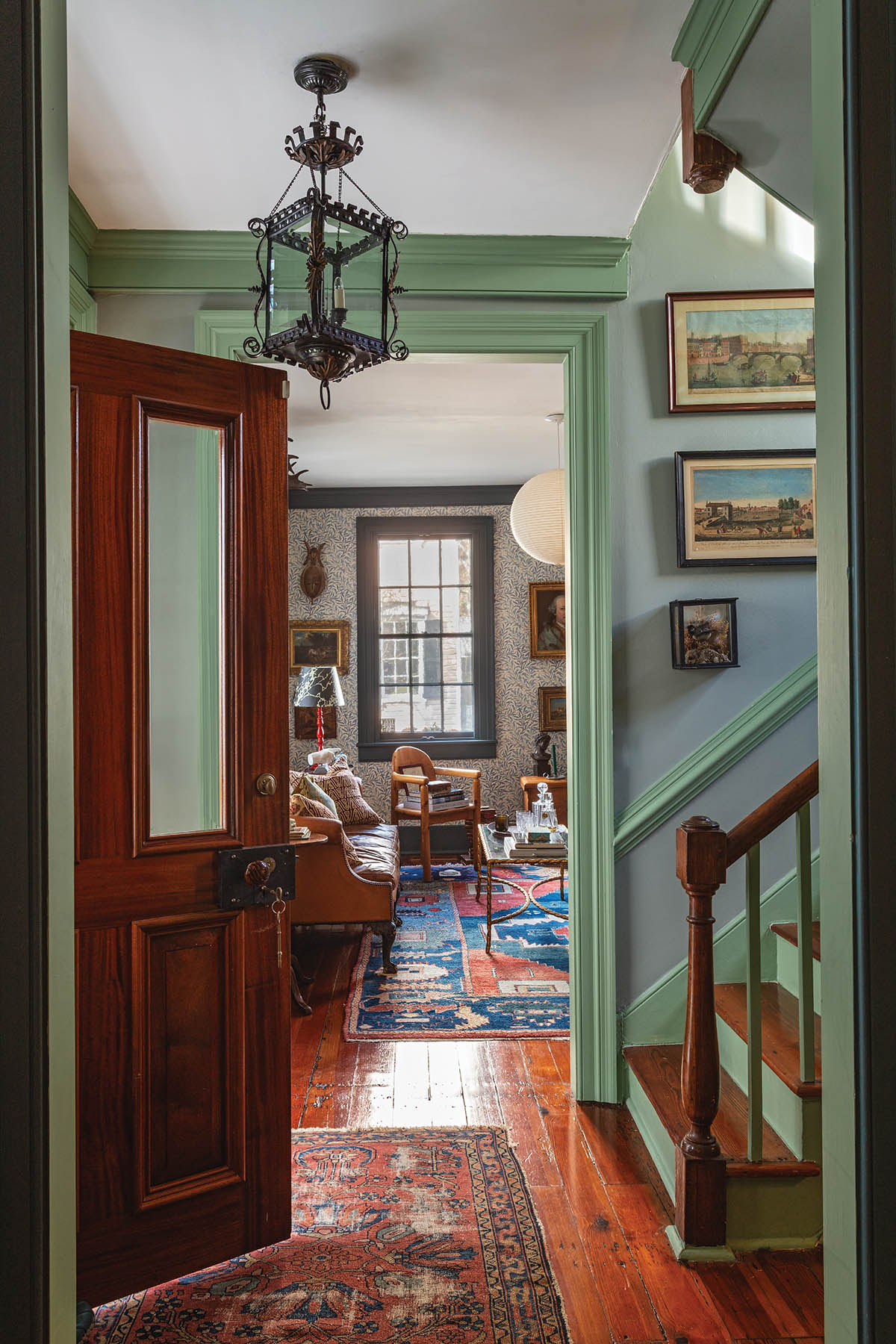
The house had undergone a full restoration in the early 2000s, including a rear addition that added a den and second staircase leading to a full primary suite. “That made it pretty livable,” he says. While the house didn’t require extensive renovation, for him, an interior redesign was in order. Reeves replaced the former light palette with his moody, layered style. White trim shifted to deep blues and greens, while pale gray walls were covered in patterned wallpapers, creating a cozy cottage feel with strong visual impact.
A classic 1960s Land Rover in the driveway, alongside Barbour Wellies and wicker baskets in the front hall, sets the stage for the home’s English cottage vibe. Inside, the spaces are built around pieces collected over time: a Spanish chest here, a Danish chair there, and a mix of art and objects tracing connections to family, music, and travel. “I like the sum of the parts. I like to collect things and then mash them together, have different eras overlapping and crossing paths,” says Reeves. “It just makes for a more interesting space, because I don’t live in a period.”
The narrative unfolds in the front parlor, where the walls are wrapped in William Morris “Willow Boughs” paper, a pattern also used at Highlander. Its organic forms provide a soft backdrop for art. A Noguchi lantern glows overhead, illuminating a vignette of patterns and textures: an 18th-century Aubusson Verdure tapestry, antique chairs covered in Beata Heuman “Dappled Velvet” fabric, a Persian rug, and an English oak secretary that houses Reeves’s record player and vinyl collection. “I’m analog,” Reeves says. “Books, vinyl records everywhere, Victorian taxidermy. Everything has a story. That’s the fun part; each object sparks a thought, emotion, or memory.”
Velvet throw cushions embroidered with plump pheasants also reference Highlander, where Reeves used the Schumacher fabric on several headboards. Other British motifs abound: a needlepoint map of English counties hangs near a maquette of James Joyce’s Dublin statue, while a portrait of a stern-eyed gentleman presides over the room like a watchful ancestor.
There’s a method beneath the layered charm. “I can connect the dots from the colorways; they work their way around the room,” says Reeves. “The teals in the tapestry bring together the greens and the blues in the room, then the golds and ochres bring you to the browns and oranges in the furniture.” It’s a room designed for both gathering and indulging in solitude. “I wanted a parlor to be able to entertain people, to have a drink at night, to read the paper on a Sunday, play records, and make a fire. It’s a good place to do all that.”
If the parlor is whimsical, the dining room is theatrical. A raw pine Danish dining table adds a mid-century modern contrast to the House of Hackney “Arborea” wallpaper that wraps the room in a fantastical forest. A monumental painting by Doug Higgins anchors the space. English spirit decanters glint on the sideboard; Reeves’s banjo rests by the fireplace; and a bust adorned with a crown waits in the corner. “It’s playful but powerful,” he says. “I like the clash of eras.”
Beyond the traditional Charleston single hyphen lies a compact kitchen, breakfast nook, and the rear addition. There, a spacious den is painted in a deep Farrow & Ball “Oval Room Blue,” creating a bold warmth balanced by pops of orange and green. An oversized sofa salvaged from an English country house—“they called it a ‘little plumper,’” Reeves says—anchors the room. A Moroccan Tuareg rug underfoot connects it to two timeworn armchairs flanking the brick fireplace, while stacks of books leaning against the rear staircase reflect the room’s primary use. French doors open to a small courtyard garden.
The second floor hosts the private spaces: a guest room, Cricket’s cheerful bedroom, and a tranquil primary suite anchored by another large-scale work by Doug Higgins. A light wicker bed and a surfboard introduce a more relaxed note. “It speaks to another side of my brain,” says Reeves.
Rather than a single overhaul, the house has evolved incrementally, growing in tandem with Highlander Mountain House and its new sister property, Outpost Inn. While Reeves feels it reflects the mood and mix he envisioned, he plans to continue refining the home over time. “It’s a work in progress,” he says. “But it’s the right size for me and my daughter, and it lets me try ideas to use in the hotels. It all connects.”